By David Iler, LMT, CPT. Licensed massage therapist since 2004, certified personal trainer, and founder of Iler Method® massage therapy in Austin, Texas.
A client once brought her foam roller to a session. Not a photo of it. The actual roller, black, dense, scuffed pale along one edge from two years on a garage floor. She set it on the floor next to the table and said, “Tell me what I’m doing wrong with this thing.”
She wasn’t doing anything wrong.
That’s the part that’s hard to hear. She had been rolling her right hip every morning for two years. Seven or eight minutes, most days, before coffee. And the hip still tightened by noon. The roller was doing exactly what a roller does. It just wasn’t reaching the thing that kept rebuilding the tightness overnight.
I get some version of this question every week, from people who are doing more self-care than the average person will do in a lifetime.
What Does a Foam Roller Actually Do?
A foam roller increases blood flow to a large muscle group and gives you a short window where the tissue feels looser and moving feels easier. That is real. It’s also temporary by design.
Rolling covers ground. You put weight on a long section of muscle and move across it, which means the pressure is spread thin and never stays anywhere long. The specific hardened spots where chronic tightness lives need the opposite. They need sustained, still pressure held in one place, roughly 30 to 60 seconds, long enough for the muscle to stop guarding and let go.
Most people roll fast. Most people roll wide. Both of those are the enemy of an actual release, which is why the relief fades on the drive to work.
Why Does the Relief Fade by Lunchtime?
Because the load that built the tightness is still running.
Your body isn’t symmetrical on the inside. The right lung is larger than the left. The liver sits on the right. The diaphragm attaches unevenly to the spine. Those structures create a built-in bias, and the muscles organize around it the same way in every body. That organization is normal. It’s healthy. It’s also the reason your body was built to move in every direction, forward and back, side to side, and rotating both ways, so the work gets shared.
Modern life took away most of those directions. Sitting faces forward. Driving faces forward. Running, cycling, lifting, rowing, all forward. I call it linear life, and being athletic doesn’t get you out of it. A person who runs forty miles a week is still moving in almost exactly one plane.
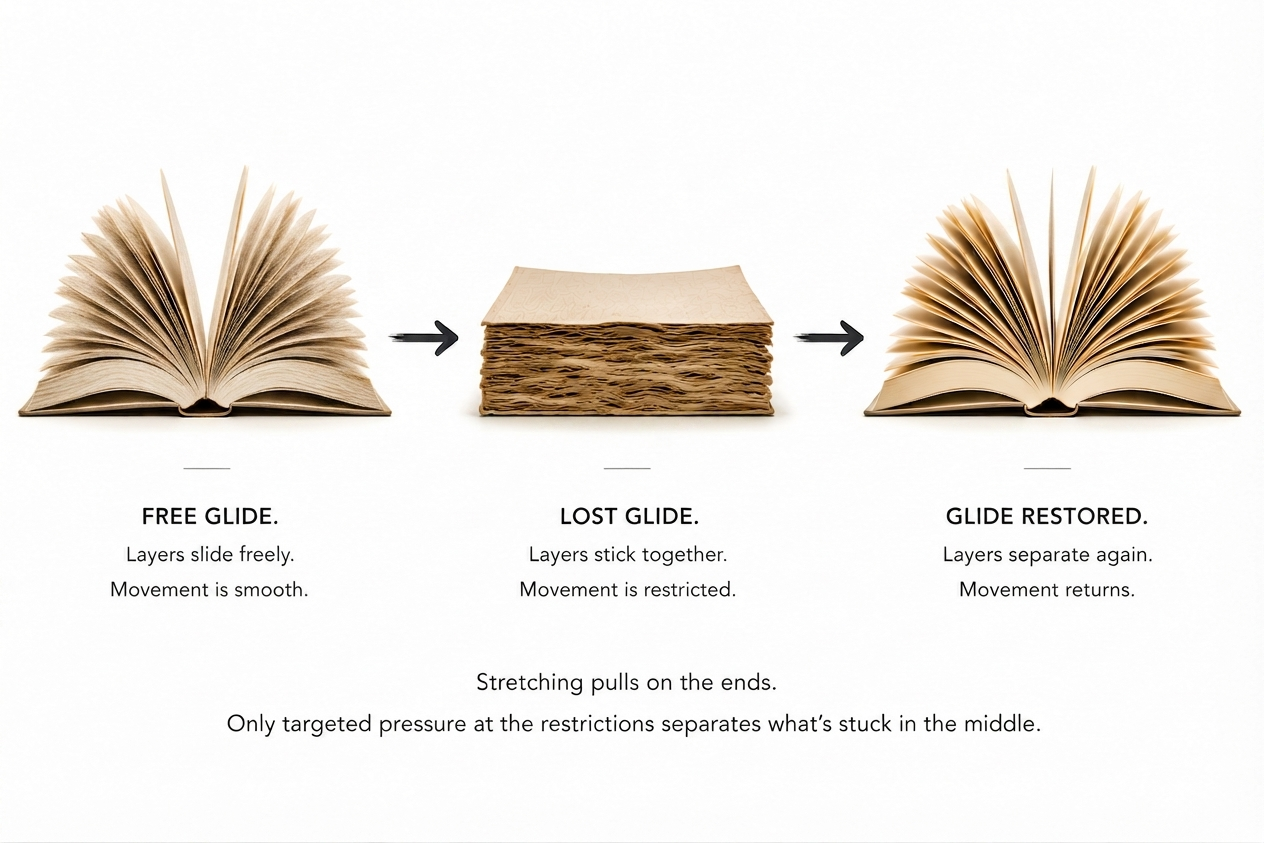
So the same chains handle everything, all day, for years. The tissue along them gradually hardens into trigger points, which are knots inside the muscle fibers, and adhesions, which are layers of connective tissue that have bound together and stopped sliding. Trigger points cost you strength. Adhesions cost you range. Neither one dissolves because you passed over it with a roller for ninety seconds.
Ten minutes of rolling against sixteen hours of forward-facing load is not a fair fight. For a fuller look at how that load moves through the body, see this overview of muscle overcompensation.
Why Doesn’t Rolling the Spot That Hurts Help?
Here’s the second reason the roller underperforms, and it has nothing to do with technique.
The place that hurts is usually the end of the story, not the beginning. Pain shows up where the chain finally ran out of room. By then the overload has been building somewhere upstream for years, quietly, in a muscle that never once complained. You can roll the loud spot every day for a decade. If the quiet one keeps sending it work, the tightness comes back on schedule.
Client Case: Marcus, 41
Marcus is a cyclist who also runs a couple of half marathons a year. He came in because his right knee ached on long rides and the outside of his right thigh burned by mile thirty.
He had been rolling his right IT band daily for about two years. He described it as the most painful thing he does all day, and he’d been told that meant it was working.
The IT band is connective tissue. It’s a thick band of fascia running down the outside of the thigh, and it isn’t a contractile muscle. It doesn’t build knots the way muscle does, and it doesn’t lengthen because you grind on it. Rolling it hurts a great deal and changes very little.
What was pulling on it was hardened tissue in the muscles that feed into it: the glute and the tensor fasciae latae at the hip, and the outer quad below. The right hip had been carrying an outsized share of his load for years, and the IT band was just the cable transmitting the tension. His thigh was the messenger.
The work started at the hip and moved down the chain. Over several sessions the load began distributing again, the burning on long rides eased off, and the knee quieted. He still rolls. He just moved the roller about eight inches north of where he’d been putting it.
Identifying details changed; some cases are composites.
How Do You Get More Out of the Roller You Already Own?
Stop rolling. That’s the short version.
Find the tender spot, park on it, and stay there. Let your body weight do the work while you breathe slowly, and hold until the sharpness of the spot dulls into something duller and more tolerable. That softening is the signal. Thirty to sixty seconds is usually the window.
For small, specific spots, a lacrosse ball or a firm massage ball concentrates pressure far better than a roller can. Save the roller for large muscle groups, quads, hamstrings, upper back. Use the ball for the hip, the glute, the shoulder blade, the calf.
Then take the pattern seriously. Add movement in the two directions your day is missing, which for almost everyone is sideways and rotational. Lateral steps. Banded side walks. Slow trunk rotations. Five honest minutes of non-forward movement does more to keep the tissue from rebuilding than another twenty minutes on the roller.
Specific instructions for working the common spots at home are in this guide to trigger point therapy at home.
When Does Foam Rolling Make Things Worse?
Rolling aggressively over already irritated tissue can extend how long that area stays cranky. Same with rolling directly on a fresh strain, or on anything hot, sharp, or swollen. Speed is the usual culprit. Fast back-and-forth rolling on an overworked muscle reads as more irritation, not release.
If a spot is acute or inflamed, work the muscles around it and leave the spot alone. And if you have numbness, tingling, weakness, or pain that wakes you at night, that belongs with a physician before it belongs under a roller. Those are medical questions. Massage works the muscular layer only.
The Roller Was Never the Problem
Your foam roller is a good tool being asked to do a job it was never built for. It can’t find the specific spot. It can’t stay still long enough. And it has no way of knowing that your right hip is why your left shoulder is complaining.
None of that is a failure of effort. Almost everyone who ends up on my table has already tried harder than they should have needed to.
It just means the work is being done in the wrong place.
The Pain Map: Why Being Strong & Fit Isn’t Enough is available now at bit.ly/painmap-book.
If you’re in Austin and the tightness keeps coming back no matter how much you roll, book a Discovery Session by clicking Schedule Now.
Frequently Asked Questions
Why does foam rolling feel good but not fix anything?
Foam rolling increases blood flow and gives brief relief, but rolling across a large area never keeps pressure on one spot long enough for a release. Hardened trigger points need sustained, still pressure of roughly 30 to 60 seconds. Most people roll too fast and over too much ground to ever reach that point, which is why the relief fades within hours.
How long should I hold a foam roller on one spot?
Hold steady on a tender spot for 30 to 60 seconds without rolling. Let your body weight apply the pressure and breathe slowly until the sharpness of the spot begins to dull. That dulling is the signal the muscle has let go.
Should I foam roll my IT band?
Rolling the IT band directly is painful and rarely produces lasting change, because the IT band is connective tissue rather than a contractile muscle. The tension usually originates in the muscles that attach into it at the hip and the outer thigh. Working those muscles addresses what is actually pulling on the band.
Is it bad to foam roll every day?
Daily rolling is fine for most people when it’s done slowly and on healthy tissue. Problems come from aggressive speed, from rolling over inflamed or recently injured areas, and from expecting a roller to resolve a pattern that keeps rebuilding all day. Pair it with movement in the side-to-side and rotational directions your day is missing.
Can foam rolling make my pain worse?
Yes, when it’s done aggressively, over already-inflamed tissue, or on a recent injury. Rapid back-and-forth rolling can irritate an overworked muscle instead of releasing it. If a spot is hot, sharp, or swollen, work the muscles around it instead and see a physician for anything involving numbness, tingling, or weakness.
What does Iler Method massage do that a foam roller can’t?
Iler Method massage locates the specific hardened tissue along an overloaded chain and holds sustained, oil-free pressure on it, including spots you cannot reach or apply enough pressure to on your own. The work also follows the chain rather than staying at the painful area, which is where a roller is structurally limited.
Where is Iler Method massage therapy located?
Iler Method massage therapy is located at 248 Addie Roy Road, Suite B-105, Westlake Hills, TX 78746, serving clients throughout the Austin, Texas area. New clients begin with a 60-minute Discovery Session.