
By David Iler, LMT, CPT. Licensed massage therapist since 2004, certified personal trainer, and founder of Iler Method® massage therapy in Austin, Texas.
Hypermobility and chronic pain are connected, but not the way most people assume. Hypermobility isn’t spread evenly through the body. Not every joint and not every muscle. Some areas lock down to protect while others loosen, and the muscles around the locked-down areas are the ones overworking. That’s usually where the work belongs. The loose areas can hurt too, but stretching them gives nothing back, because they’re already long.
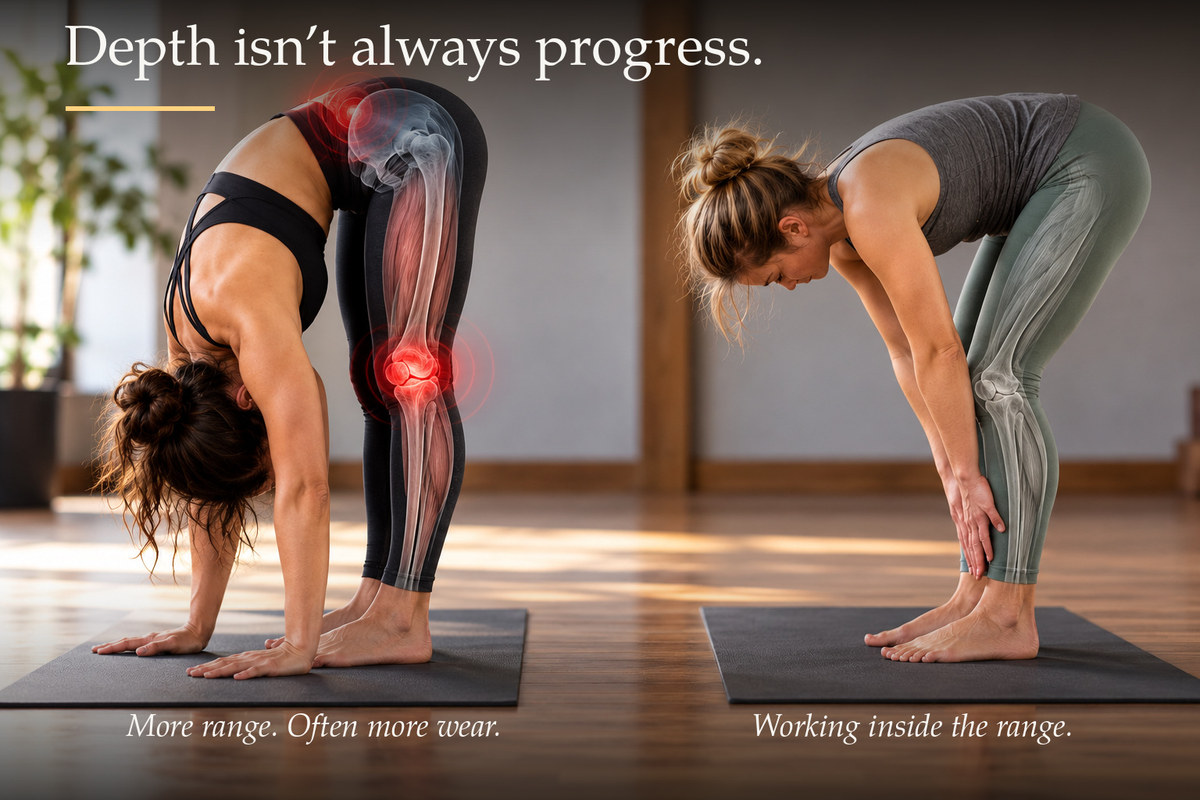
Someone in a yoga class folds forward and puts their palms flat on the floor. The instructor says “beautiful.” Three rows back, someone else gets to mid-shin and stops. Everyone in the room assumes the first person is doing better.
That assumption is worth examining, because the people who end up on my table with years of chronic pain are often the ones who could always go deeper than everybody else.
What hypermobility actually is
Hypermobility means joints that move past what’s considered a normal range. Published estimates put generalized joint hypermobility at roughly 10 to 20 percent of adults. A much smaller group, around 3 percent, has the version that comes with ongoing musculoskeletal pain.
So being bendy is common. Being bendy and hurting is the smaller group, and that’s the group I see in the Austin area.
Hypermobility can also be part of a diagnosed condition such as hypermobility spectrum disorder or hypermobile Ehlers-Danlos syndrome. Those are diagnosed and managed by a physician. My work is the muscular layer only. If you have or suspect a connective tissue condition, that belongs with your doctor, and anything I do sits alongside their care rather than in place of it.
A bendy person isn’t bendy everywhere
Here’s what almost nobody gets told. Hypermobility isn’t a whole-body setting. It isn’t every joint and it isn’t every muscle.
Some joints have extra room. Others don’t. And the muscles around them aren’t sharing the work evenly either. Some lock down to protect a joint that travels too far. Others loosen. What you end up with is a body that’s generous in some places and guarded in others, often on the same limb.
That uneven distribution is the part that matters, and it’s the part a depth-based assessment misses entirely. How far you can fold forward says nothing about which of your joints are carrying the extra range.
Compensation and overcompensation
Every body compensates. That’s normal and it’s universal. Muscles trade work back and forth all day long, and that trading is what lets you move at all. Compensation is healthy.
Overcompensation is what happens when one muscle has been carrying more than its share for too long. It isn’t a different mechanism. It’s the same one, run past where it should have stopped. In overcompensation, some muscles overwork and some underwork.
When you have extra range to spend, that gap opens sooner and it opens wider. Muscle overcompensation is the pattern underneath most of the chronic pain I see, and hypermobility accelerates it.
Local pain is the last thing to show up, not the first
This is the piece most people have backwards. The sore shoulder or the aching hip feels like the beginning of the problem. It’s usually the end of a long sequence.
The body was carrying an uneven load for years before anything hurt. Muscles took on work that wasn’t theirs, other muscles quietly stopped contributing, and the whole arrangement held up fine until it didn’t. The pain arrives when one link finally runs out of room.
Which is why the work starts locally but can’t stay there. Addressing the painful area is where we begin, because that’s what’s loud. Getting the pattern to change means working the whole chain that led to it.
The pain usually sits on the side that’s been covering
In my practice, hypermobile clients are rarely loose where it hurts most.
The painful area is usually the part that locked down and took on the work, not the part with the extra range. It’s been holding the line for everything around it, and the pain is the bill for that.
The loose areas aren’t silent either. A joint with too much travel can ache on its own. What differs is what each one needs. One has been overworking and needs the work. The other is already long and doesn’t need more length.
This is also why referred pain shows up so often in this group. Hypermobile clients tend to feel work in one area register somewhere else, more vividly and more often than most people do. I take that as useful information. It tells me the pattern is running further through the body than usual, and it tells me where to look next.
Why stretching the sore spot doesn’t relieve it for long
The instinct is to stretch whatever feels loose and achy. In a hypermobile body that’s usually the area with the extra range, and it’s already long. Adding more length to it gives nothing back.
We look at the other end. The muscles that need the work are around the joints that locked down, and they’ve been carrying the load the loose side stopped carrying. That’s where the trigger points sit, and that’s where the work goes.
So the relief fades. You get a few hours, sometimes a day, and then it returns, because nothing changed about the load or about the muscles that have been absorbing it.
The useful question isn’t how much range you have. It’s which areas have been covering for it.
What about yoga and dance
Contact sports are the obvious load on a hypermobile body. Football and lacrosse put force into joints from angles the body didn’t choose, and a joint with extra room absorbs that force differently.
The surprising ones are yoga and dance.
You’re asking an asymmetrical body to perform symmetrical movements. Both sides at once, matched, held. Your body isn’t built matched. Nobody’s is. And in a room of twenty people, an instructor is reading depth as progress, which means the hypermobile person gets encouraged to go exactly as far as they shouldn’t go.
That isn’t a knock on yoga or on instructors. It’s a cueing problem. Very few are trained to spot someone whose joints move past normal in several places at once, and fewer know what to do with it.
What the work looks like
The goal isn’t to get looser. You already have the range. It isn’t to brace everything down either.
It’s to find which joints carry the extra room, which areas locked down to cover for them, and then work the ones that actually need it. Those answers are specific to you. They’re not the same as the answers for the person next to you on the mat.
Most of our work runs on a six or twelve session framework, because changing a pattern that took years to build isn’t a one-visit proposition. The first session is where we map it.
Questions people ask
Is hypermobility the same as being flexible?
No. Flexibility is range you’ve built through training, usually in specific areas you’ve worked. Hypermobility is joint range beyond what’s considered normal, and it’s largely structural. A flexible person earned their range. A hypermobile person was issued it.
How common is hypermobility?
Published estimates put generalized joint hypermobility at about 10 to 20 percent of adults. Roughly 3 percent have the version accompanied by chronic musculoskeletal pain.
Should a hypermobile person stretch?
That’s a question for you and your physician or physical therapist, and the answer depends on which of your joints carry the extra range. What I can say from the table is that the areas people reach for first are usually the loose ones, and those are already long. The muscles doing the overworking are generally around the joints that tightened up, which is a different place entirely.
Can massage help with hypermobility?
Massage doesn’t change joint structure or connective tissue laxity. What I work with is the muscular layer: the areas that have been overworking, the areas that stopped contributing, and the pattern connecting them. Whether that’s useful for your situation is something a hands-on assessment answers better than an article can.
Why does my pain keep coming back to the same spot?
Because the spot is usually a symptom of a pattern rather than the origin of one. Until what it’s been covering for changes, the area goes back to carrying the same load it was carrying before.
If you’re in Austin
If you’re hypermobile and you’ve been chasing the same sore spot for years, a Discovery Session is where we find out what’s actually carrying the load. Sixty minutes, in Westlake Hills.
Book a Discovery Session by clicking Schedule Now.
This article is general information and not medical advice. Hypermobility spectrum disorders and connective tissue conditions are diagnosed and treated by a physician. Massage therapy addresses the muscular layer and is not a substitute for medical care.

